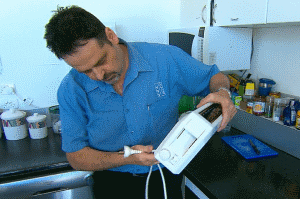
When a qualified technician visits your workplace to test and tag electrical equipment, they don’t just plug in a machine and stick a label on it. The process is governed by AS/NZS 3760:2022 — the Australian and New Zealand standard for in-service inspection and testing of electrical equipment — which specifies exactly which tests must be performed on each type of appliance, and in what order.
Understanding what these tests involve helps you know what you’re paying for, what the results mean, and why some appliances require different tests to others. Not every appliance undergoes the same electrical tests.
AS/NZS 3760:2022 specifies exactly which tests apply to each type of equipment. Here’s a plain-English guide to every test required under the standard.
Quick Reference: Tests Required Under AS/NZS 3760:2022
| Test | What It Checks | Equipment Used | Applies To |
|---|---|---|---|
| Visual Inspection | Cord, plug, body, guards, socket — physical condition and safety | Eyes + torch | All appliances — always first |
| Insulation Resistance | Integrity of insulation protecting users from live parts | Portable Appliance Tester / Insulation Resistance Tester | Class I and Class II appliances |
| Leakage Current | Current leaking to earth when appliance is powered up | Portable Appliance Tester connected to mains (not battery) | Appliances with soft switches; Class II items |
| Polarity | Active and neutral wires connected correctly; no short circuits | Portable Appliance Tester or Multimeter | Extension leads, power boards and cord sets where polarity must be verified |
| Earth Bond / Earth Resistance | Earth connection can handle fault current; resistance no greater than 1 ohm | Portable Appliance Tester (higher current test) | Class I appliances |
Note: Not every test applies to every appliance. Which tests are required depends on the appliance class and construction. See ‘Which Tests Apply to Which Appliances?’ below for a full breakdown.
Visual Inspection
Approximately 90% of faults are identified from visual inspection prior to the completion of any electrical tests. A true visual inspection, conducted by a reputable service provider involves a comprehensive inspection of flexible supply cord, plug, appliance and socket. Covers and guards are checked to ensure they are attached, appliances are checked for rattles indicating the presence of small foreign objects that may interfere with the electrical safety of the appliance, and Class II appliances are checked for deep engraving which may impact on the insulation of the appliance. This is why visual inspection is considered the most important part of the inspection and testing process.
Insulation Resistance
An Insulation Resistance test is required to check the integrity of the insulation that is protecting users from the live parts within the appliance. In the majority of cases, an Insulation Resistance Tester, or PAT (Portable Appliance Tester) is used to complete the insulation resistance test on an appliance.
Some items contain a soft switch which means that current must be applied to the item – effectively turning the item on or “powering it up”– in order for it to be tested. A Leakage Current Test should be completed on items with a soft switch.
Leakage Current Testing
This test involves “powering up” the appliance and measuring any current leakage. Leakage Current testing requires the appliance to be energised from the mains. ATS technicians use PATs capable of performing all tests required by AS/NZS 3760:2022, including leakage current testing where applicable.
Polarity
A polarity test verifies that the active, neutral and earth conductors are correctly connected throughout an extension lead, power board or other cord set. This test confirms the conductors are correctly terminated and that there are no short circuits between them. Modern Portable Appliance Testers (PATs) perform this test quickly and accurately as part of the overall test sequence.
Earth Bond / Earth Resistance
Earth resistance testing verifies that the protective earth connection between the plug and any exposed metal parts of a Class I appliance is continuous and has a sufficiently low resistance to allow fault current to flow safely. Under AS/NZS 3760:2022, the measured resistance must not exceed 1 ohm.
Modern Portable Appliance Testers (PATs) typically perform this verification using an earth bond test, which applies a higher test current than a basic continuity test. This provides greater confidence that the protective earth connection will perform correctly if an electrical fault occurs.
A basic earth continuity test simply confirms that an earth path exists. An earth bond test performs the same verification using a substantially higher test current, providing greater assurance that the earth conductor and its terminations can carry fault current safely.
Understanding Appliance Classes — Why They Matter
Throughout AS/NZS 3760:2022, electrical appliances are categorised into classes based on how they protect users from electric shock. The class of an appliance determines which tests must be performed on it — which is why a technician might apply different tests to different items during the same visit.
| Class | How It’s Protected | Common Examples |
|---|---|---|
| Class I | Relies on earth connection as backup protection — has a 3-pin plug | Power tools, kettles, toasters, office equipment, computers, extension leads |
| Class II | Double-insulated — does not rely on earth connection; typically 2-pin plug or figure-8 connector | Phone chargers, laptop power supplies, some power tools (marked with double square symbol ⧈) |
| Class III | Operates on extra-low voltage (ELV) — inherently low risk | Items powered by SELV transformers or batteries (not typically in scope for AS/NZS 3760:2022) |
How to identify the class: Class II appliances are marked with a double square symbol (⧈) on the appliance label. If you don’t see this symbol and the appliance has exposed metal parts and a 3-pin plug, it’s almost certainly Class I. When in doubt, your ATS technician will identify the class and apply the correct tests automatically.
Which Tests Apply to Which Appliances?
The tests required depend on the appliance’s construction, electrical class and how it operates. For example, a double-insulated phone charger requires different testing to a three-pin electric kettle, and a modern appliance with electronic controls may require leakage current testing instead of an insulation resistance test.
| Appliance Type | Visual | Insulation | Leakage Current | Polarity | Earth Bond |
|---|---|---|---|---|---|
| Class I (standard 3-pin) | ✓ | ✓ | — | — | ✓ |
| Class I with soft switch | ✓ | — | ✓ | — | ✓ |
| Class II (double insulated) | ✓ | ✓ | — | — | — |
| Class II with soft switch | ✓ | — | ✓ | — | — |
| Lead with rewireable plug/socket | ✓ | ✓ | — | ✓ | ✓ |
| Extension lead / RCD lead | ✓ | ✓ | — | ✓ | ✓ |
Key points:
- Visual inspection is always performed first on every item, regardless of its class.
- Earth Bond testing only applies to Class I appliances, as Class II (double-insulated) appliances have no protective earth connection to test.
- Leakage Current testing is used instead of Insulation Resistance testing for many soft-switch or electronically controlled appliances, where an insulation resistance test may not produce a meaningful result because the internal switching circuitry is open or electronic components may be affected.
- Polarity testing is required for extension leads, power boards and other cord sets to verify the correct connection of the active, neutral and earth conductors, regardless of whether the plug is factory-moulded or rewireable.
What Happens When an Appliance Fails a Test?
If an appliance fails any test — visual or electrical — it must be taken out of service immediately.
The ATS technician will:
- Apply a FAIL tag to the appliance with the date and reason for failure
- Document the failure in your digital asset register via the AIM portal
- Assess whether an on-site minor repair (plug or cord replacement) can resolve the fault
- Retest the item immediately if a repair is completed on-site
- Recommend next steps for items requiring more significant repair
The most common causes of failure are visual — damaged cords, cracked plugs, missing guards, and signs of heat damage or water ingress. This is why the visual inspection is so valuable: approximately 90% of faults are identified before a single electrical test is run.
How ATS Performs These Tests
ATS technicians use calibrated Portable Appliance Testers (PATs) to perform all required electrical tests quickly and accurately on-site. Modern PATs automate the test sequence — the technician connects the appliance, selects the correct test profile for the appliance class, and the PAT automatically performs the applicable tests for the selected appliance type producing a pass/fail result in seconds.
All results — including numerical test readings — are recorded digitally and uploaded to your ATS AIM portal in real time. You receive a complete asset register showing every item tested, the specific tests performed, the results, and the next scheduled test date. This record is your compliance documentation in the event of a WHS inspection or insurance query.
Important: Battery-powered PATs cannot perform Leakage Current testing — this test requires the PAT to be connected to mains power. ATS technicians use mains-connected equipment on every job to ensure all required tests can be completed, including leakage current where applicable.
Ready to have your electrical equipment tested to AS/NZS 3760:2022?
ATS provides professional test and tag services across Australia and New Zealand.
Get a free quote below or call 1300 287 669.

Get a free quote
"*" indicates required fields